




What is HIFU treatment? How it works, what it feels like, results, safety and cost
Contents
HIFU stands for high-intensity focused ultrasound. It is a non-surgical treatment that lifts and tightens skin by heating tiny points of tissue deep under the surface, including the layer a surgeon tightens in a facelift, so the body builds new collagen around them over the following months. One session treats an area, there is no cutting, no needles and no time off, the result builds to a peak at about three months, and for most people it holds for twelve to eighteen months. It is used on the face, jawline, under the chin, the neck, the brow and eye area and the décolletage, and with a different handpiece on the body. At RT Aesthetics in Whickham, Newcastle, HIFU is one of the most booked treatments, the device is the ULTRAcel Q+, and prices run from £895 for the eyes and brow to £1,495 for the face, lips, neck and décolletage together. This guide explains how it works, what a session is like, what it can and cannot do, and what it costs.
The short version
- HIFU sends focused ultrasound to the layer a surgeon tightens in a facelift, so the skin lifts and firms without cuts, needles or downtime.
- One session is enough for most people. Some tightening shows on the day, the real result builds over two to three months and lasts 12 to 18 months.
- It feels like a hot prickle under the skin and takes an hour or two. Redness and mild swelling for a few hours afterwards are normal.
- At our Whickham, Newcastle clinic: face £1,095, face and neck £1,295, neck £995, eyes and brow £895, double chin £995. The assessment is free.
What HIFU does, in plain terms
Skin sags for two reasons that build up together: the collagen and elastin in the skin thin out and lose their spring, and the layer of tissue under the skin that holds the face in place loosens. Creams work on the surface. Injectables relax muscles or add volume. HIFU is the only non-surgical treatment that reaches the deeper holding layer, called the SMAS, and it does it from the outside, through intact skin. Each point of tissue it heats contracts straight away, which is the small lift you see on the day, and then heals by laying down fresh collagen, which is the firmer, lifted result that appears over the following weeks. Our HIFU results guide goes through that timeline month by month.
How HIFU works: the three depths
An ultrasound handpiece focuses sound energy to a precise depth under the skin, the way a magnifying glass focuses sunlight to a point. At that point the tissue is heated to around 60 to 70 degrees for a fraction of a second, which is enough to make a tiny column of collagen contract, while the surface of the skin stays cool because the energy only meets at the focus. The practitioner works in lines across the area, and each line lays down a row of these points a few millimetres apart. The ULTRAcel Q+ cartridges we use work at three depths. The 1.5mm cartridge treats the skin itself, for texture and fine lines. The 3mm cartridge treats the deeper dermis, where most of the collagen sits, for firmness. The 4.5mm cartridge reaches the SMAS, for lift. A full face treatment layers all three, and the lower depths are used with care around the eyes and over bone.
What a HIFU session is like
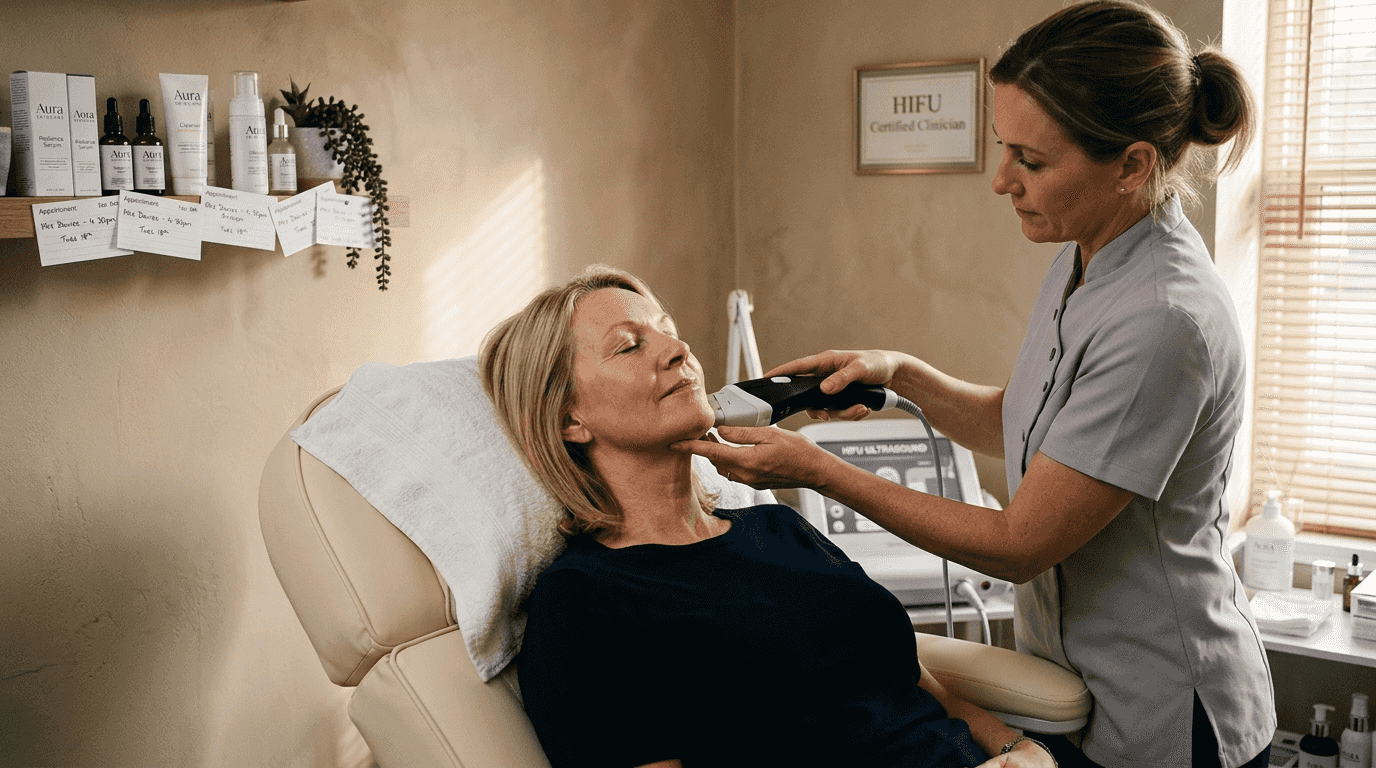
Your practitioner cleans the skin, marks the area into a grid, applies ultrasound gel and works through the lines one at a time, with the handpiece pressed flat to the skin. Each pulse feels like a hot prickle or a deep ache that lasts a second, sharper over the jawbone and the brow and mild over the cheeks. Most people describe it as uncomfortable rather than painful, and the practitioner can turn the energy down over the sensitive spots or take a short break. The eyes and brow or the double chin alone take under an hour; the full face and neck together take closer to two. Afterwards the skin is pink for an hour or two and can feel tender to the touch for a few days, and that is the whole recovery. You can drive home, go back to work and put makeup on the same day. Our aftercare guide covers the few things to avoid in the first week.
Which areas HIFU treats
Face and jawline
The most common treatment. It sharpens a softening jawline, lifts early jowls, firms the cheeks and softens lines that are there at rest. Our guide to getting a more defined jawline sets out what HIFU adds to the rest.
Under the chin and the neck
HIFU reduces the fat pad under the chin and tightens the skin over it in the same session, which is why it suits a double chin that comes with a softening jawline. On the neck it treats crepey skin and the early turkey neck. Our HIFU chin and jawline guide goes through it in detail.
Brow and around the eyes
A lift of a few millimetres at the tail of the brow, which opens the eye, and a tightening of the loose skin on the upper lid and under the eye. See HIFU for eye bags and hooded eyes.
Décolletage
The chest is treated with the shallower cartridges to firm the skin and soften the vertical lines that sun and side-sleeping leave there.
Body
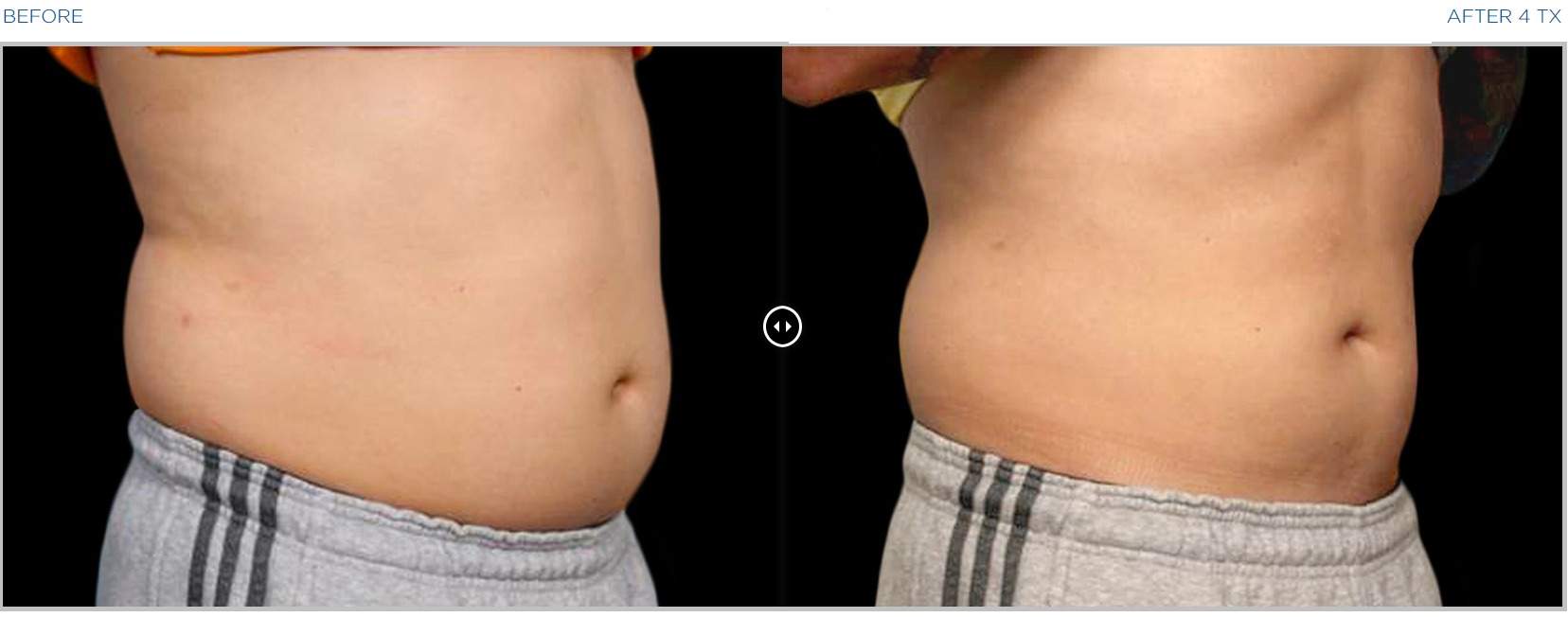
With a larger handpiece HIFU tightens loose skin on the upper arms, the inner thighs and the abdomen after pregnancy or weight loss. Our HIFU body page sets out what each area realistically gives.
HIFU results: what to expect and when
You see a small tightening on the day, then very little for a few weeks while the collagen rebuilds. From week six to eight the jawline starts to look cleaner and the skin denser, the peak lands at about three months, and some areas keep improving to six months. Most people need one session; heavier laxity sometimes needs a second eight to twelve weeks later, and we tell you which at your assessment. The result holds for twelve to eighteen months for most people, and a single maintenance session around then keeps it. Nobody can promise you a surgical result from a non-surgical treatment, and if HIFU is not going to do what you want, we say so before you book. Our clients' HIFU treatment reviews are on the site unedited.
Who HIFU suits and who it does not
HIFU makes the biggest difference to people over thirty with mild to moderate laxity: a jawline that has softened rather than dropped, a neck that has started to crepe, skin that has lost its density, a brow that sits lower than it did. Under thirty the skin is usually still firm enough that there is little to lift. Heavy jowls that hang, a neck in folds and advanced sun damage are beyond what any non-surgical treatment can do, and a surgeon is the honest answer. HIFU is not carried out during pregnancy, over open lesions, active skin infections or severe acne, or over metal implants in the treatment area, and your assessment covers the rest. When HIFU is not the right fit, it is often Exilis Ultra Face, the gentler radio frequency option for fine lines and the eye area, or anti-wrinkle injections for the lines that movement makes.
HIFU side effects and safety
The usual side effects are redness for an hour or two, mild swelling, and tenderness to the touch for a few days. Some people get a little bruising, or patches of numbness or tingling that fade over a few weeks. Rarer problems, such as welts, small burns or temporary weakness in a facial muscle, come from too much energy in the wrong place, and the way to avoid them is a clinical device with the depths set correctly and a practitioner who does HIFU every week rather than now and then. Our HIFU side effects guide covers each one and how long it lasts. RT Aesthetics is a medically led clinic, so every treatment follows written protocols, and there is a clinic medic and a qualified nurse practitioner on the team for any medical questions.
Why the device matters
HIFU is a category, not a brand, and the difference between a clinical system and a cheap import is the difference between a lift and a sore face. A clinical device delivers a known amount of energy to a known depth, with cartridges that are replaced when they are spent, and it produces a result you can measure. The handheld and salon machines sold under the same name often cannot reach the SMAS at all. We use the ULTRAcel Q+, and our page on the ULTRAcel Q+ 7D explains what its cartridges and its faster linear mode change. Whatever clinic you choose, ask which device it is, who is treating you and how they were trained on it, and how many lines are included, because a full face that uses half the energy is not a full face.
HIFU compared with the alternatives
Exilis radio frequency heats the skin more gently over a course of four sessions and suits fine lines, crepey skin and the eye area; HIFU gives the bigger lift in one session. Our Exilis or HIFU guide compares them area by area. Anti-wrinkle injections stop the muscle movement that makes lines when you frown or raise your brows, which HIFU does not, and a lot of people have both. Dermal fillers add volume where the face has hollowed, which HIFU does not either. Skin boosters improve skin quality from within the dermis, and our HIFU vs skin boosters comparison sets out where each fits. Ultherapy is a branded HIFU system with the same principle at a higher price; our Ultherapy vs HIFU guide covers the differences. A facelift lifts further and lasts longer, with a general anaesthetic, scars and weeks of recovery, and it is the right answer for heavy laxity. Our guide to treatments for wrinkles sets the whole range side by side.
What HIFU costs in Newcastle
HIFU is usually one session: eyes and brow lift £895, double chin £995, neck £995, full face £1,095, face and neck £1,295, and face, lips, neck and décolletage together £1,495. A body area is £1,295 in a single session, and your assessment is where we tell you whether it needs one session or two. Your assessment is free, 0% finance over 12 months is available on plans of £1,000 or more subject to a credit assessment, and we price match like-for-like clinic treatments. The HIFU cost guide explains why prices vary so much between clinics, and the HIFU Newcastle page has everything in one place.
HIFU treatment near me: where we are
If you searched for HIFU treatment near me, what is HIFU or a HIFU clinic in Newcastle, we are at The Knowles, Front Street, Whickham, Newcastle upon Tyne, NE16 4SN, about ten minutes from Newcastle city centre and the MetroCentre and about fifteen from Gateshead town centre, with free parking on Front Street and in the village car parks. Clients come for HIFU from Sunderland, Durham, Hexham, Northumberland and Teesside, and evening appointments run until 8:30pm Monday to Wednesday. Call 0191 649 8699, text 07307 201681 or book a free assessment online, and you will get a straight answer on whether HIFU is right for you before anything is booked.
Frequently asked questions about HIFU
What does HIFU stand for?
High-intensity focused ultrasound. The same physics is used in hospitals at much higher energies to treat tumours and fibroids; cosmetic HIFU uses far lower energy, focused a few millimetres under the skin, to tighten collagen.
Is HIFU painful?
It is uncomfortable rather than painful for most people: a hot prickle or deep ache with each pulse, sharper over bone. The practitioner adjusts the energy over the sensitive spots, and there is no pain afterwards beyond tenderness to the touch.
How many HIFU sessions do I need?
Usually one. Heavier laxity sometimes needs a second session eight to twelve weeks later, and a maintenance session every twelve to eighteen months keeps the result.
How long does HIFU last?
Twelve to eighteen months for most people, longer for some. You will read "up to three years" on some sites; that is the outer edge for a young face with mild laxity, not the normal case.
Can HIFU go wrong?
Rarely, and almost always because of a poor device or an untrained operator. Welts, burns and temporary muscle weakness are the problems that make the news, and the questions in the device section above are how you avoid them.
Does HIFU work on the body?
Yes, with a larger handpiece, for loose skin on the arms, thighs and abdomen. It tightens skin rather than removing fat; for a pocket of fat, fat freezing does more.
Not sure which treatment you need?
Book a free 30 minute assessment at our Whickham clinic. No pressure, an honest answer and a written price.
Or call 0191 649 8699 or text 07307 201681
More on HIFU
- HIFU before and after photos
- Does HIFU work? Results and who it suits
- How long HIFU takes to work and how long it lasts
- Five things to know before your first HIFU treatment
- The pros and cons of a HIFU facial
- HIFU side effects and how long they last
- How much a HIFU facial costs
- HIFU treatment reviews from our clients
- HIFU for eye bags and hooded eyes
- HIFU for the chin and jawline
- Exilis vs HIFU
- Ultherapy vs HIFU
- HIFU body treatment
- HIFU treatment at our Newcastle clinic
Our Other Blogs
Our goal is simple: safe treatment, results you can measure, and support that carries on after you leave the clinic.
Over 1,000 five star reviews